
How Chinese brands, refurbishment and scarce supply are reshaping the forklift market
The market for material handling equipment is shifting on several fronts at once. Demand for new machines is under pressure, Chinese brands are gaining ground and manufacturers are focusing more and more on used machines. At the same time, the supply of used machines is shrinking, while trade outside Europe is becoming more difficult. Koen Lisman, CEO of Lisman Forklifts, shares his view and explains why he expects the current dip to be followed by a peak in 2028 and 2029.
Key takeaways
- Demand for new machines is under pressure
- Chinese brands are catching up in quality and service
- Manufacturers are holding on to used machines themselves
- Fewer and more worn used machines are coming back, partly due to Covid
- Koen expects a V-shaped dip, followed by a peak in 2028–2029
Demand under pressure
Demand for material handling equipment follows demand in other sectors. Where factories and distribution centres invest, machines are bought; where that stalls, demand for machines falls too. Any look at the market therefore starts with the customer.
“Forklifts are mainly used in industry and logistics. These are exactly the sectors that have taken heavy blows, particularly in Germany when you look at car manufacturing and mechanical engineering. This is partly cushioned by the defence industry, and investment in sustainable energy remains a driver of demand for equipment. What is clear is that demand for new material handling equipment is under pressure. The market is not keeping pace with the European and global economy. There are always a few bright spots, but sentiment is more negative than positive.”
Robotisation picks up speed
Another factor with a growing impact on the material handling equipment market is robotisation. “This leads to cannibalisation of conventional machines. The share is still relatively small, but robotisation is expected to see strong growth. Faster than any other segment.” Driven by the shortage of staff and the automation ambitions of (larger) companies, the share of automated forklifts worldwide is set to grow by around 20 per cent a year over the next five years. The pace is picking up. “The rapid development of humanoids in combination with AI is going to put the step to robotisation within reach of a much wider audience.”
“That growth won’t follow a straight line. Full automation is still a step too far for many companies. Costs, integrating automation into existing processes and the lack of qualified staff are holding back the roll-out, so companies are more likely to take an intermediate step first. Think of smart assistance systems on conventional machines and investment in rental and leasing models that reduce risk. This leaves room to try out automation without having to invest heavily straight away.”
China means business
Overall demand for used forklifts and other material handling equipment is under pressure. That pressure is increased by the growing dominance of Chinese producers. “The product mix is being challenged. Traditional OEMs are feeling great pressure from Chinese competitors. This creates a situation in which the pie to be divided is much smaller. At the same time, the costs of oil, raw materials, steel and labour have risen in the West and have remained virtually flat in China.”
The continued advance of Chinese players is a major factor in the fall in sales figures. Compared with the ‘all-time high’ in 2023, sales are down by ‘tens of per cent’. “The fact that the market is smaller is not a good sign. A large part of the market is now served by Chinese producers.” The Asian brands are also making a leap in quality and gaining an ever firmer foothold in Europe, South America and Asia as a whole.
“Look at the car industry. With more than a hundred car manufacturers, the market is being flooded. It is no different for forklifts. There is an oversupply of brands and of production capacity. Now that the Chinese economy is cooling, selling abroad is how China keeps its production capacity up. It has become a more ‘aggressive’ product, and a better one too. With the exception of certain machine types, such as high-lift reach trucks, order pickers and VNA trucks, where European brands remain stronger.”
Europe’s edge, China’s price
It’s not only in quality but also in visibility, service and reach that Chinese brands are taking an increasingly prominent position in the market. That push is intensified by weakening domestic demand in China and overcapacity in production. From European hubs, Chinese brands are closer to the market. “Greater delivery reliability, local assembly, building a dealer network: Chinese brands are investing in Europe. This puts them ahead of looming import duties, but just as important is the fact that this approach also lays the foundation for a European service network. And forklifts are a service product.”
European manufacturers still have an edge. For now. “Their machines are traditionally of high quality and ergonomically sound, and dealers and users rely on a strong service network. Fast response times when something breaks down, parts in stock: that’s where European brands are stronger. Where ‘Europe’ comes up short is price. The price gap is big enough to push customers towards the Chinese competitor anyway. These are mainly smaller operations. Large-scale logistics operators run around the clock, and for them a quality guarantee is paramount.”
“The full-service, back-to-back lease contracts that European manufacturers offer still give them a competitive edge with large fleet owners. Chinese machines also still have a weak residual value, so the total cost of ownership (TCO) is higher than it looks at first sight. But China has matured and become more competitive.”
OEMs go second-hand
Falling demand and price competition from other parts of the world mean European manufacturers are increasingly looking at the used market. Importers and manufacturers are making more room in their range for young used machines alongside new ones.
“Large manufacturers are increasingly holding on to used machines themselves, and that development is very clearly visible.”
The thinking behind this is simple: not every application needs a new machine. Telematics and data give an ever clearer picture of how machines are used. “Not everything has to be ‘heavy duty’. A machine that runs only a few hours a day doesn’t need to be built for intensive daily use. For a large client, that makes a mixed fleet of new and refurbished machines a strong proposition, because not all machines are used equally intensively.”
“It also opens up a new sales market for manufacturers. By focusing on used machines, manufacturers strengthen their competitive position against China. They also make use of their own capacity in parts and availability. This compensates for the decline in sales of new machines.”
Refurbished and ready again
Jungheinrich was the first ‘big name’ to set up a ‘refurbishment centre’ in Dresden (Germany). As a result, production of new machines at that site was scaled back. Linde and Toyota followed this example.
“These brands are able to put used machines back on the market in like-new condition. In many cases the used machines are almost comparable to a new machine.”
This approach fits with the need to make better use of capacity and with the sustainability proposition. Companies are obliged to report on ESG performance: their impact on the environment, people and governance. “On the environmental side, you score well by giving machines a second life. Add competition and capacity and it leads to European manufacturers reinventing themselves.”
The long shadow of Covid
Change is coming from several directions at once. Industry is ordering less, automation is slowly taking over part of the conventional machines and Chinese brands are advancing in quality, service and accessibility. European manufacturers are responding by focusing on what they already have in-house: quality, parts and a strong service network, now extended to nearly-new machines. And on top of that, the effects of the Covid pandemic are only just becoming clear.
“There are effectively fewer used machines becoming available. Fewer in number, fewer in volume. I call this the ‘Covid effect’. During the pandemic, supply chain disruptions made lead times shoot up. Machines that had been sold were only delivered in 2023, so hardly any new machines reached the market in the meantime. That means fewer machines are now coming back from those years. The pool of used machines returning today is under pressure, both in quality and in quantity. It is a direct result of Covid.”
Stock will be key again
Quantity is only half the problem. The machines that do come back are in worse shape than before. “OEMs hold on to the better machines. Everything we buy now is of lower quality than it used to be: more hours on the clock, harder use, more wear and tear.” Wholesalers can partly make up for that by adding value. “Light refurbishment can make up for part of the lost quality, but the costs have risen sharply too, especially for wear-and-tear parts.” All of this feeds through into prices, which for a long time were held down by Chinese competition and weak economic sentiment.
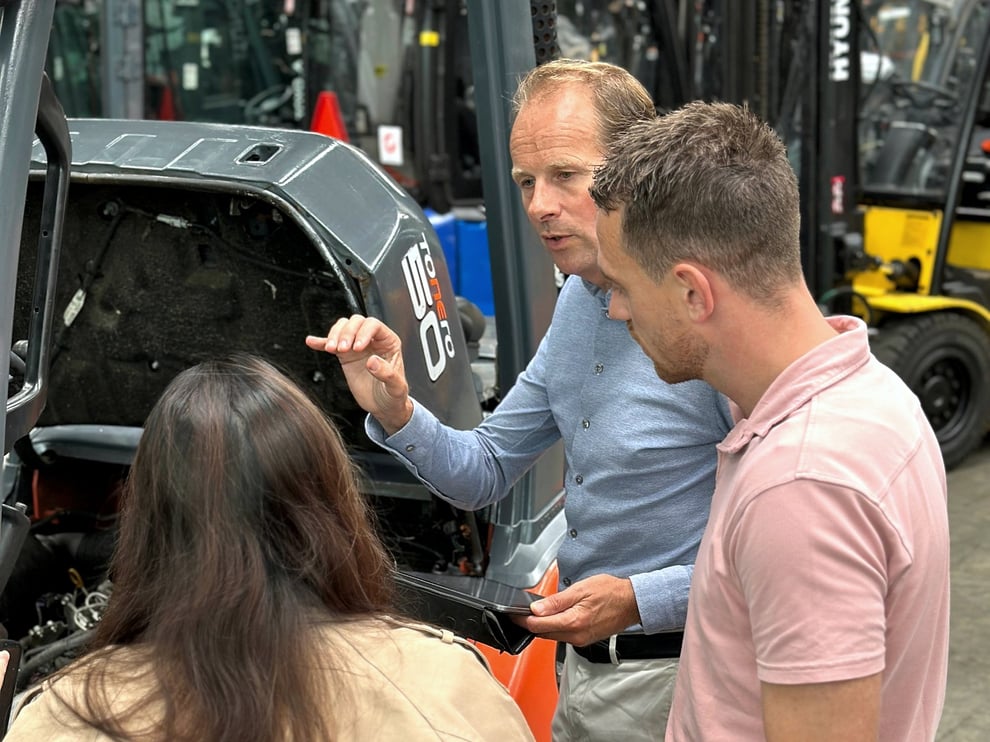
Koen Lisman inspecting a used forklift at Lisman Forklifts.
“Wholesalers that are cash-rich are sitting on good stock at the moment. But it is very likely that stock will dwindle and prices will go up.” Factor in scarcity and rising raw material costs, and the conclusion is clear: stock will be key again.
The pressure shifts to buyers. “Wholesalers’ customers are not buying for stock at the moment; they buy when they need a machine. With the market development I am predicting, there is a good chance you will come away empty-handed. Then you can’t serve end-customer demand either. The small retailers will have to build up small stocks of their own. That is a game changer.”
Then there are interest rates. “They are rising and may keep rising. Financing stock then becomes another hurdle. Banks are not cooperative when it comes to granting credit. SMEs become even more dependent on a good relationship with wholesalers to keep meeting demand.”
Trade turns local
Supply is not the only thing under strain. International trade is hitting barriers too. “The European Union is closing ranks, but doing business outside Europe is becoming more complicated. Everyone is putting up walls. International trade is flowing less freely, so it is harder for supply and demand to find each other.”
Serving the global market is becoming a ‘growing challenge’, driven by instability and rising costs. “Oil and diesel prices are pushing freight costs up, and that eats into the advantage of free movement we enjoy in Europe. Sea freight is affordable but slow, and you have to pre-finance it. Road transport is the other way round.”
“To put that in perspective: transport costs on the routes we use most have doubled. Over the same period, the prices of our machines have gone up by five per cent.” Anyone who wants to stay profitable has to change tack. “Buying and selling locally is becoming more important, for economic reasons and for sustainability.”
A V-shaped dip
“Earlier downturns show how quickly the tide can turn. In 2009, European orders fell by almost half. They bounced back by a third in 2010 and by nearly a quarter in 2011. Covid was different: order intake barely dropped, but deliveries were massively delayed. So the V was mainly in invoicing and delivery, not so much in sales volumes. This time, I’m expecting a V-shaped dip, followed by a peak in 2028 and 2029.”
“The explanation lies in the machine life cycle. Lease contracts for forklifts typically run for around five years. What was barely produced in 2020 and 2021 isn’t coming back now: that is the dip. What was delivered in 2022 and 2023, once the Covid backlog had been worked through, will start coming off lease between roughly 2027 and 2029.”
The forklift cycle at a glance
| Period | What happens |
|---|---|
| 2020–2021 | Hardly any new machines delivered due to Covid |
| 2022–2023 | Covid backlog delivered |
| Now | Few used machines coming back: the dip |
| 2027–2029 | Machines from 2022–2023 come off lease: the peak |
“The timing isn’t fixed, though: in times of economic uncertainty, many fleet owners extend their lease contracts instead of renewing them, which can stretch the cycle. Alongside that, there is a cautious economic recovery, with German investment in defence and infrastructure supporting growth through 2028.”
What does this mean for your stock?
Good used machines are getting harder to find. View our current stock or contact your Area Manager to discuss your needs.

How is the market developing in your region?
Share your experience or view below. Koen and our team look forward to reading it.